From hand-blown crown glass and gold-leaf storefront lettering to the float glass revolution, the 1966 patent that started building film, blast-rated security film, TEMPEST shielding, glass that switches from clear to frost at the flip of a switch, and the storefront graphics trade — the full researched story, with dates, names, and sources, and its gaps marked plainly where the record runs out.
1959Float glass announced to the world, 20 January — the substrate everything after it is applied to
19663M issued the first sun-control window film patent — the birth of architectural film
1973The oil embargo turns solar film from a novelty into a building-energy product
1984First PDLC patent — the liquid-crystal science behind switchable film is born
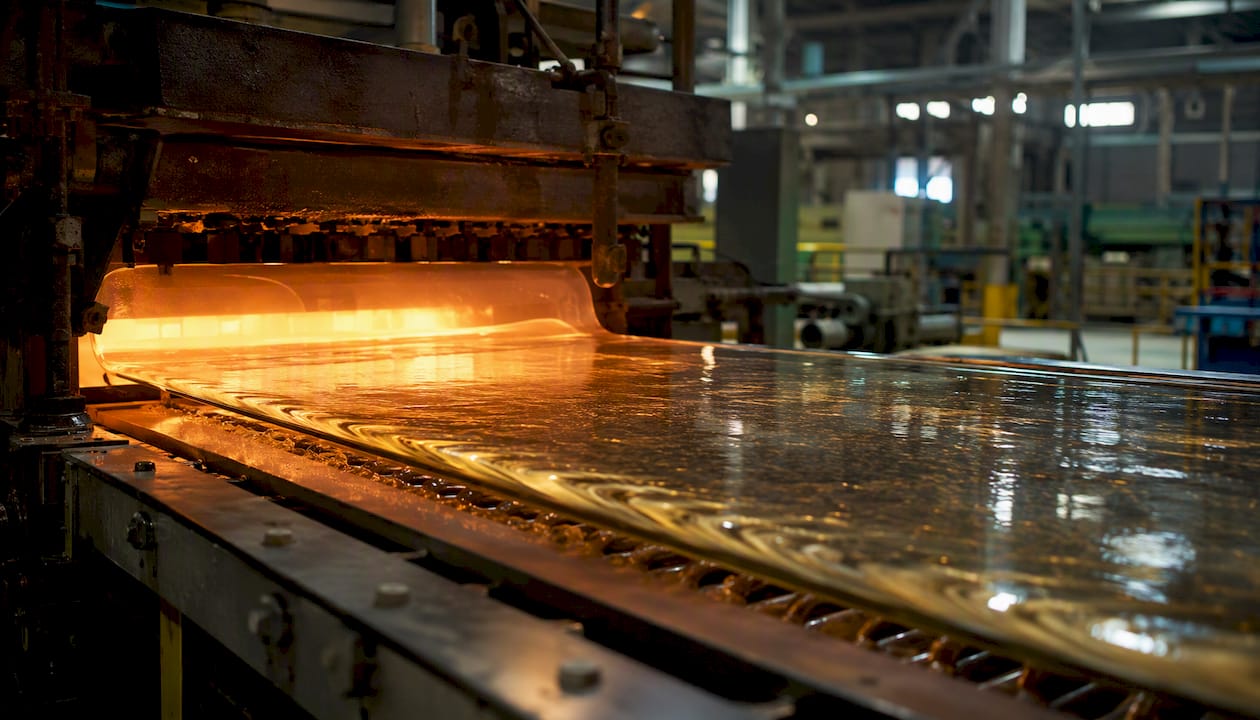
Float glass production — the process that made large, flat, affordable panes the default. Photo: Cloudy2Clear Windows.
How to read the flags
Unmarked facts are corroborated by a primary or institutional source. A single / weak source flag means the claim rests on one dealer, vendor, or trade source. Where sources disagree, both versions are given. A vendor claim is a company describing itself — carried as a claim, not a settled fact.
Chapter 01
Flat Glass Itself
For most of history, a flat pane of glass was small, wavy, and expensive. Four ways of making it — crown, cylinder, plate, drawn sheet — each pushed size and clarity a little further, until one idea in 1952 replaced all of them: float the glass on molten tin.
Roman era — Small green panes
Glassblowing developed in the eastern Mediterranean around the mid-1st century BCE. Roman builders used small, uneven, green/blue-green flat panes — flat glass existed, but as a luxury, not a building material.
DGWS history of glass window glazing (summarising Corning Museum material)
1226 — Broad sheet in England
“Broad Sheet” was first produced in Sussex in 1226, using the mouth-blown cylinder technique developed in Germany in the 11th century: blow a cylinder, cut off the ends, slit it lengthwise, reheat and flatten it into a sheet.
Architectural glass — Wikipedia · Eco-Strip, history of glass windows
c. 1330 — Crown glass, Rouen
Crown glass was first produced in Rouen, France around 1330 and perfected by French glassmakers in the 14th century. A gather of glass was spun open by centrifugal force into a disc — clearer than cylinder glass, but small, and every disc carried the central “bullion” or bullseye. Crown glass was first produced in London in 1678 and dominated until the 19th century.
Architectural glass — Wikipedia
1500s–1600s — Plate glass
Venetian Murano mirror-makers backed plate glass with mercury-tin amalgam in the 1500s; “blown plate” was first produced in London in the 1620s. From the late 17th century, casting glass and then grinding and polishing both faces produced larger, clearer panes — at a cost that limited plate to mirrors, palaces, and prestige buildings. In the US, cylinder glass replaced crown around 1825.
Architectural glass — Wikipedia · JRank, Glass
1838 — Rolled plate patent
James Hartley was granted a patent in 1838 for Hartley’s Patent Rolled Plate — an early step toward mechanised flat glass.
Architectural glass — Wikipedia
1874 — Tempered glass patented
François Barthélemy Alfred Royer de la Bastie patented glass tempering in England on 12 August 1874 (Patent No. 2783), quenching near-molten glass in oil or grease — the ancestor of the toughened glass film is applied to today.
McGill Office for Science and Society, safety glass history
1898 — Wired cast glass
Pilkington first commercially produced wired-cast glass in 1898, embedding wire mesh in cast glass for early safety and security glazing.
Architectural glass — Wikipedia
1903 / 1909 — Laminated glass
French chemist and artist Édouard Benedictus discovered in 1903 that a flask coated inside with cellulose nitrate broke without scattering its shards. He turned the accident into “Triplex” and patented it in 1909. PVB has been the standard interlayer since 1939.
McGill Office for Science and Society, safety glass history
1913 — Machine-drawn sheet
Machine flat-drawn sheet glass was first produced in Belgium in 1913 in one secondary account; the Fourcault process drew a continuous ribbon of glass vertically from a vat — bigger and cheaper than blown sheet, but still not truly flat or distortion-free.
Eco-Strip, history of glass windows
1932 — Insulated glass precursor single / weak source
American engineer C.D. Haven patented “Thermopane” in 1932, cited as the first major step in the commercialisation of double glazing.
Ecopreneurist, history of double glazing
1952–1959 — The float revolution
December 1952 — Alastair (later Sir Alastair) Pilkington began experimenting with floating molten glass on a bath of molten tin, so gravity and surface tension would do the flattening and polishing that grinding never could.
10 December 1953 — the first float patent was applied for by Pilkington and Kenneth Bickerstaff (GB 769,692).
July 1958 — the first sheet made entirely by the float process, after seven years of development. The cost of getting there is disputed: a patent-history paper says £7 million; Pilkington’s own current history page says £28 million — sources disagree, both reported.
20 January 1959 — float glass was announced to the glass-making world. Fire-polished, parallel, distortion-free, with no grinding or polishing step, it superseded both plate and sheet glass and had replaced them across Western Europe and North America by the mid-1970s. Today roughly 90% of world flat glass is float (secondary figure), made on about 500 float lines worldwide (Pilkington).
Licensing spread it fast: Japan’s NSG contacted Pilkington a week after the 1959 announcement, signed a licence in March 1964, and started Asia’s first float line on 15 November 1965. An earlier precursor is worth noting for honesty: Henry Bessemer experimented with pouring glass onto liquid tin in 1843 and patented a roller ribbon system in 1848 — sources differ on which date attaches to which experiment, and neither was a commercial success. It was an idea ahead of its industry.
Pilkington — the invention of float glass · Patent history of float glass (ScienceDirect) · NSG 100th anniversary · Open University, float glass
Modern architectural glass
The assemblies film is applied to now assembled themselves over the following decades. Low-E coatings were developed in the 1970s after the US energy crisis and popularised in the 1980s; Pilkington’s on-line hard-coat K Glass launched in 1989. Pilkington’s sponsored 200-year history also dates fire-resistant glass to 1978 and Pilkington Activ, billed as the world’s first self-cleaning glass, to 2001 — treat that “world’s first” as a vendor superlative. Tempered, laminated, and insulated units (sealed cavities, later low-E coatings plus argon fill) became the standard glazing stack.
Pilkington K Glass range · ArchDaily — 200 years of innovation in architectural glass · Ecopreneurist, history of double glazing
Chapter 02
The Birth of Window Film for Buildings
Window film was invented for float glass: a metallised plastic skin that could retrofit the huge, flat, cheap panes float made normal. The concept dates to the early 1950s; the commercial birth is a single patent in 1966.
Early 1950s–early 1960s — The concept
Trade histories trace the concept of window film for solar-control flat glass application to the early 1950s (Sea-Cool), with IWFA-derived trade text placing the early-1960s work on controlling heating and cooling imbalance in buildings. Read the 1950s as concept and the 1960s as commercial birth. One claim to leave out: Sea-Cool’s story that 3M created “Scotchshield” in the 1950s for military aircraft glare has no corroboration and is not carried here as fact.
Sea-Cool, history of window film · Window Tint FL, short history of window films
1966 — 3M’s first patent
3M states it plainly: “3M was issued the first sun control window film patent in 1966.” Trade accounts specify US Patent 3,290,203, issued 6 December 1966 to Minnesota Mining and Manufacturing, for a metallised solar-control film. Every architectural film sold today descends from this document.
3M architectural window films · ClimatePro, 3M window film history · Green Lodging News
First generation — dyed film
The first films were dye-based, two-layer constructions: a dyed absorbing layer plus adhesive. The dyes broke down under UV — bubbling, fading, and turning purple. That failure mode became the trade’s defining sales story: every later generation (metallised, hybrid, ceramic) was sold against the purple bubble film of the first generation.
EngineerFix, when was window tint invented · Cool Sunlight, window film history
1969 — Clear security film
Three years after the solar patent, in response to terrorist bombings in Europe, clear security film was introduced to hold broken glass in place. Multiple dealer and secondary histories agree on 1969; no primary 3M page confirming the exact date was found, so the date is widely repeated and secondary-supported rather than primary-verified.
PA Window Tint · Solar Works Atlanta, history of residential window film
1973 — The energy-crisis boom
The OAPEC oil embargo of 1973 changed what film was for. Demand for reflective solar film surged, and the focus expanded from summer heat rejection to winter heat retention — the push that started low-emissivity film development. Solar film became a building-energy product, sold on payback, not just comfort.
Cool Sunlight, window film history · Tint Depot, window film industry history
1970s–80s — Adhesives mature single source
Pressure-sensitive adhesives in the 1970s enabled installation in humid climates; clear dry adhesives in the 1980s eased handling.
Tint Depot training material
1980s–2000s — Metallised, hybrid, ceramic
The generations that followed are dated differently by different dealer histories, so the honest summary is a sequence, not a set of birthdays: sputtered and vacuum-metallised films matured through the 1980s–90s (metallisation is intrinsic to the 1966 patent itself); hybrid dye-plus-metal films followed, dated to the early 1990s by several dealer histories; then non-metallised ceramic, nano-ceramic, and multi-layer optical films arrived in the late 1990s–2000s — sold on avoiding both the mirror look and the signal interference metallised film causes (see Chapter 4).
Solar Works Atlanta, history of residential window film
How architectural film split from automotive tint
The two trades use different physics. Automotive film is designed to absorb solar energy and be heat-formed to curved glass; architectural flat-glass film is designed to reflect heat — and absorptive auto film applied to flat glass can build up heat and break it. That is why “tint is tint” has always been wrong, and why the flat glass trade is its own discipline.
Institutionally, the split shows in the dates: the International Window Film Association (IWFA) began in 1988 over automotive regulation and was formally formed in 1991, bringing in manufacturers, distributors, and dealers; in 2010 the separate architectural/technical manufacturers’ effort was merged into the IWFA. (Fringe claims of an IWFA founded in 1985 or the early 1980s are weaker.)
Madico, architectural vs automotive film explainer · IWFA history profile
Chapter 03
Safety & Security Film
Security film’s job is simple to say: when glass breaks, hold it together. Its history is written by the events that proved why that matters — bombings, hurricanes, and school shootings — and by the standards those events forced into existence.
1983–84 — Beirut and Kuwait
18 April 1983, US Embassy Beirut; 23 October 1983, the Marine barracks bombing (241 killed); December 1983, the Kuwait embassy bombings; 20 September 1984, the Beirut embassy annex. The wave of attacks led to the State Department’s Inman Program — the first systematic US government push to harden buildings, glazing included.
Applied Research Associates anti-terrorism criteria paper (uploaded copy, secondary)
19 April 1995 — Oklahoma City
The Murrah Federal Building bombing (168 killed) was the turning point for US standards. President Clinton ordered a Department of Justice vulnerability assessment; the Interagency Security Committee (ISC) was created, and the GSA established federal glazing criteria — with flying glass recognised as the mass-casualty mechanism film exists to defeat.
Journal of Window Film · SAFTI — Open, Inviting and Safe: Designing Secure Buildings
1997–2003 — The criteria get codified
GSA Security Criteria, January 1997. ISC Security Design Criteria, 28 May 2001. GSA-TS01-2003, issued 1 January 2003, defining Performance Conditions 1–5 — the pass/fail language still used to specify blast-mitigation film. The test record behind it is real: an Applied Research Associates report documents five open-air high-explosive tests of security film under the GSA protocol at Kirtland AFB, 15 February–3 March 2000, at 500 lb TNT-equivalent.
ARA blast mitigation test report, 2000 · SAFTI, codes and security glazing
7 August 1998 — Nairobi & Dar es Salaam
The East Africa embassy bombings killed 224 and injured roughly 5,000. The Crowe boards criticised reliance on Mylar film in Nairobi — one force-protection report attributes to Nairobi the claim that “more than 90 percent of those killed and wounded were victims of flying glass” (that figure is attributed to the report and was not independently verified). The outcome split the market: laminated glass for new embassy construction, film as the retrofit tool for everything already standing.
Through a Glass, Darkly — force protection equipment report
The standards shelf
Blast testing is governed by ASTM F1642 (airblast loadings on glazing systems), F2248, and F2912, with ISO 16933/16934 internationally. Hurricane work is tested to ASTM E1886/E1996. One caution worth printing on any directory page: film alone is not a code-approved hurricane product everywhere — 3M’s own commercial brochure notes window films are not approved in Florida for hurricane/windstorm impact protection.
SAFTI, codes and security glazing · 3M commercial window films core brochure · RC Window Films (dealer source)
14 December 2012 — Sandy Hook, and the school wave
The Sandy Hook shooter entered by shooting out the front glass beside the school offices. Campus Safety magazine (April/May 2015) reported safety and security film sales had “skyrocketed” (Mike Dorn, Safe Havens International), with at least 22 districts adopting it — 12 in Connecticut, 7 in Illinois; Geneva, IL District 304 filmed entryways and first-floor glass in nine buildings. Connecticut put real money behind it: $21.1M in grants to 111 districts (2013–14) and $21.6M to 98 districts (2014–15); Illinois committed $25M in May 2014.
The IWFA’s position, which every honest directory should repeat: security film is not bulletproof. Typically 4–21 mil, often with an attachment system such as Dow 995 wet glaze — it holds shattered glass together and delays entry, and delay is what saves lives.
Campus Safety Magazine · Solar Gard — Upgrading School Security with Window Film · Commercial Window Shield, school security film
Anti-graffiti film — origin unknown
Sacrificial, replaceable clear film that takes the etch or the tag so the glass doesn’t is standard practice on storefronts and transit glass — but no founding date, inventor, or first product could be reliably sourced. It is listed in the unverified section rather than given an invented birthday.
Chapter 04
Signal Interference & RF Shielding Film
The strangest branch of the family tree starts in Cold War espionage: the discovery that electronic equipment leaks information through the air — and that a building’s windows are the hole in the shield.
TEMPEST roots
US intelligence discovered in the 1950s that unintended electromagnetic emanations from equipment could be intercepted and reconstructed — you could, in effect, read a machine from outside the room. TEMPEST became the codename for the vulnerability and its countermeasures. Ross Anderson’s Security Engineering (Cambridge) traces side-channel attacks on crypto equipment to around WWII, US/UK suppression struggles through the 1950s, NATO TEMPEST standards work in the 1960s, secret NATO standards by 1980, declassified in 2000.
A SCIF (Sensitive Compartmented Information Facility) is a Faraday enclosure — and windows are the hole in it. RF/IR-attenuating film closes the aperture while keeping daylight, at a fraction of the cost of blacked-out or fully shielded construction. Films are marketed as meeting TEMPEST requirements for ICD 705 and DoD IR/RF emanation standards, and can retrofit a windowed building toward ICD 705 compliance. (The original issue date of ICD 705 was not verified against a DNI primary source in this research, so no date is stated for it.)
1999 / 2000 — Signals Defense
The category’s dominant named US brand began operations in Owings Mills, Maryland in 1999, built around optically clear RF/IR-attenuating film. Its data sheets say that since 2000 its patented films have been “the U.S. Government’s choice for TEMPEST film protection” — that phrasing is the vendor’s own self-description. vendor self-description The performance figures are testable and stated: average attenuation greater than 40 dB across 30 MHz–6 GHz, tested to ASTM F3057-14, deployed on 1,300+ locations per a 2016 data sheet (a 2015 sheet says 1,400+ — vendor figures both).
The crossover runs both ways. Metallised solar films cause signal interference — blocking cell and Wi-Fi signal — which helped drive the non-metallised ceramic and optical films of Chapter 2. In the other direction, RF-shielding film crossed from government work into corporate boardrooms, healthcare, and privacy/security use. Today it is a small, specialist, specification-led category sold on tested dB attenuation — and its pre-1999 history exists only at the TEMPEST-programme level: no independent “first commercial RF film” or market-size source was found. That gap is flagged, not filled.
Chapter 05
Switchable Film — Clear to Frost
Glass that goes from clear to frost on command. It rests on liquid-crystal science from the 1980s — two patent families, four years apart — and a patent-expiry cliff that finally let it loose in the 2000s.
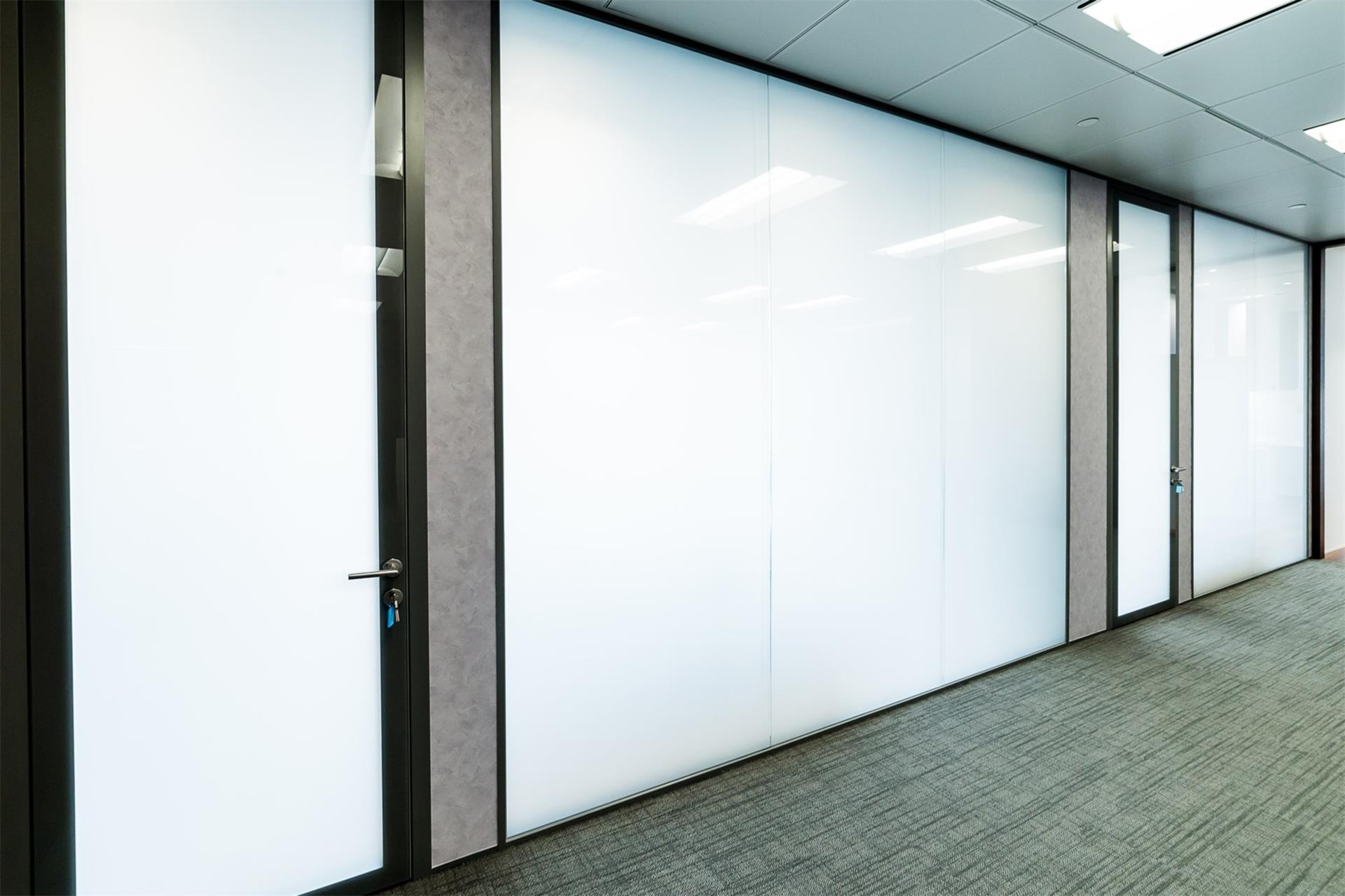
Switchable glass in its frosted state — PDLC film’s unpowered default is milky privacy; apply power and the same pane goes transparent. Photo: Glass Tint.
Friedrich Reinitzer discovered liquid crystals in 1888 — the foundational science every switchable technology stands on. The date is uncontroversial; in this research it rests on a secondary PDLC history.
PDLC Smart Film — unveiling the technology of PDLC film (Medium)
1984 — Fergason’s first PDLC patent
J.L. Fergason obtained the first patent on micro-emulsion/encapsulated liquid crystal in 1984 — US 4,435,047 — commercialised in 1987 in one thesis account. Fergason licensed exclusively to Raychem, which formed Taliq Corporation in the late 1980s to industrialise PDLC under the NCAP trademark.
Peer-reviewed PDLC review (via Gauzy) · OhioLink thesis on PDLC history
1987 — Kent State’s PDLC patents
J. William Doane and colleagues at Kent State University patented PDLC made by phase separation in 1987 — US 4,688,900 and US 4,671,618. Phase separation became the extensively used manufacturing route. In the early 1990s Raychem sublicensed the technology to 3M, Asahi Glass, Nippon Sheet Glass, and Saint-Gobain.
Peer-reviewed PDLC review · OhioLink thesis
2002 / 2005 — The patent cliff
Progress stayed constrained while the founding patents lived. The Fergason–Raychem patents expired in 2002 and the Kent State patents in 2005 — and PDLC promptly accelerated, including Asian manufacture through the 2000s. How it works: liquid-crystal droplets sit in a polymer matrix between ITO-coated PET layers; unpowered, the droplets scatter light (milky frosted privacy — not blackout); powered, they align and the pane goes transparent, drawing roughly 5 W per square metre in market-report figures. The retrofit adhesive film most flat-glass shops sell today is the later, cheaper descendant of laminated smart glass.
Peer-reviewed PDLC review · Research and Markets — switchable smart glass report
1989–2012 — The electrochromic rival: SAGE
The other switchable family tints rather than frosts. SAGE Electrochromics was founded in 1989 by John Van Dine as Sun Active Glass Electrochromics in Valley Cottage, NY; it moved its R&D to Rutgers in 1992, renamed itself SAGE Electrochromics in 1994, and set up in Faribault, Minnesota in 1998. Commercial launch and a new plant came in 2005, with first shipment in early 2006 in a trade profile (a claim of a first installation in a California hospital in 2003 is single/weak sourced). Saint-Gobain took a strategic investment in 2010 and made SAGE a wholly-owned subsidiary in 2012. SAGE’s Jean-Christophe Giron was a European Inventor Award 2015 finalist for electrochromic work. Competitor View, Inc. (founded as Soladigm; founding year not verified here) was sued by SAGE for patent infringement in 2012.
The distinction a directory has to keep straight: electrochromic is factory-glazed into an insulated unit at build time — it is not a retrofit film. PDLC film is what an installer can put on existing glass.
SAGE Electrochromics — Wikipedia · Business Excellence — SAGE Electrochromics profile · European Patent Office, 2015
The third family — SPD weak / encyclopedic source
Suspended Particle Device (SPD) film, licensed by Research Frontiers, is the third switchable family — historically more automotive and aerospace than buildings.
PDLC is the instant-privacy technology — mature, and the cheapest switchable option. Electrochromic is slow, gradual facade tinting for premium new-build. Retrofit PDLC film is the product most flat-glass shops actually sell.
Chapter 06
Color-Changing & Exotic Films
Films that change with light, with heat, or with the angle you look at them. Some of this family is sixty years old in glass form; as building film, most of it is honestly still emerging — and this page says so where the record says so.
1962 / 1964 — Photochromic glass
Photochromism was invented by William H. Armistead and S. Donald Stookey at Corning — US Patent 3,208,860, filed 31 July 1962. Corning made the first commercial release in 1964 (ophthalmic glass, silver-halide chemistry — the self-darkening eyeglass lens). Pilkington popularised photochromic lenses in the 1970s with Reactolite and Reactolite Rapide.
Corning — photochromism · Explain That Stuff — photochromic lenses
Photochromic film for buildings — emerging
As a building film, photochromic is much later and still niche. A ScienceDirect glazing review notes photochromic window films “have been recently introduced,” made roll-to-roll, modulating mainly the visible region, with little known energy-performance data. No named first commercial building photochromic/transition film or launch date could be reliably sourced — this category is emerging, not mature, and no “first” is claimed for it here.
ScienceDirect — photochromism (glazing review)
Thermochromic — the VO₂ research line
The serious thermochromic research line is vanadium dioxide (VO₂), which switches its infrared transmission at a transition temperature — extensively reviewed for thermochromic smart glass (Gao et al., Nano Energy, 2012). Commercial architectural thermochromic film remains emerging and niche in the sources found; again, no first product is claimed.
ScienceDirect — chromogenic glazing reviews
Dichroic film — documented and shipping
Dichroic is the exotic with a paper trail. 3M Dichroic Glass Finishes DF-PA — “Chill” and “Blaze” — are built from hundreds of micro-thin polymer layers: Blaze transmits cyan/blue/magenta and reflects red/gold; Chill transmits blue/magenta/yellow and reflects gold/blue, so the colour shifts with viewing angle and light. The line is documented in 3M’s installation guide Revision D (April 2018) and 2014-era design press; Goldray Glass has partnered with 3M on dichroic since 2009, including the Ohio State Chiller Plant installation in 2012.
3M’s Daylight Redirecting Film — micro-structured film that bounces daylight deeper into a room from the top of the window — appears in 3M’s 50th-anniversary (2016) window film portfolio: a reminder that “exotic” also includes films that manage light rather than block it. Decorative and designer films get their full dated history in Chapter 9 (Fasara and the storefront trade).
MRO Magazine — 3M celebrates 50 years of window film
Chapter 07
The Companies & People Who Built the Trade
Sixty years of film history is also a story of acquisitions — small coating companies folded into chemical giants, brands passing hand to hand. This is the map as the sources draw it, flags included.
3M
First sun-control window film patent 1966 (US 3,290,203); clear security film 1969 (secondary sources); 50th anniversary of window film celebrated 2016. Lines include Prestige, Fasara, Dichroic, and Daylight Redirecting films.
Madico vendor / dealer claim
Claims the first successful commercialisation of transparent reflective window films in 1958, with “nearly 100 years” of innovation. Note what that does: 1958 predates 3M’s 1966 patent — the classic patent-vs-commercialisation dispute, carried here as a claim, not a settled fact. Brands: Sun-Gard, Sunscape, SafetyShield, Decolite. Owned by Lintec.
LLumar lineage
LLumar’s history begins 1956 in Collinsville, VA, where Julius Hermes and Burness Frith founded Martin Processing. single source Courtaulds acquired it in 1987. CP Films (brands Vista, FormulaOne, LLumar, Gila) was bought by Solutia in 1999 for $200M. Solutia itself was a 1997 Monsanto divestiture that went through bankruptcy 2003–08. Eastman Chemical bought Solutia in 2012 for ~$4.7–4.8 billion — sources vary, both figures reported.
Eastman Performance Films
The post-2012 home of LLumar, Vista, V-KOOL, Hüper Optik distribution, Gila, and SunTek (Commonwealth Laminating integrated in 2014 in one account) — the largest single house in architectural film.
Solar Gard / Saint-Gobain
Solar Gard products (Solar Gard, Panorama, Quantum, Armorcoat) were manufactured for 30+ years by 2011 and sold in 90+ countries — which is why one press release’s “Founded in 1998, Solar Gard” line conflicts with the product lineage, and the lineage version is preferred here. Bekaert acquired Specialty Films in 2001; Saint-Gobain signed the acquisition 10 August 2011 and completed it 4 October 2011. Plants in San Diego, Zulte, and Suzhou. Saint-Gobain itself was founded in 1665 — older than every other name on this page combined.
Johnson Window Films
Founded 1973 by Alan Johnson (some listings say 1974/75; the company’s own 1973 is preferred), third-generation family-owned, made in the USA. On 21 January 2026, Madico announced an agreement to acquire Johnson Window Films — the trade’s map is still being redrawn.
Hüper Optik
The nano-ceramic pioneer: research began 1994 (Fraunhofer collaboration via Singapore PSB), first titanium-nitride prototype 1995, incorporated 17 May 1997 in Singapore, patented dual-layer TiN nano-ceramic technology, commercialisation in 1999.
Avery Dennison
Founded on Stanton Avery’s 1935 self-adhesive label (Chapter 9). Avery completed its acquisition of Hanita Coatings on 28 February 2017, renamed Avery Dennison Hanita — bringing an Israeli architectural film coater into the house. (A dealer blog’s “2016 for $75M” is weaker than Avery’s own release for the completion date.)
XPEL single listing, weak
Founded 1997 in Texas — primarily a paint-protection/automotive company and a later architectural entrant.
IWFA
The trade’s association: begun 1988, formed 1991, absorbed the architectural manufacturers’ effort in 2010.
Landmark launches, at a glance
1966 — 3M solar patent · 1969 — clear security film · 1989 — Pilkington K Glass (the glass side) · 1999 — Hüper Optik nano-ceramic commercialised · 2012 — 3M Fasara decorative line reaches 54 patterns (Chapter 9).
Adhesives & Sealants — Solutia to buy CP Films · Logos-World — LLumar history · ClimatePro — 3M vs the competition · FinancialReports.eu — Bekaert / Solar Gard filings · Johnson Window Films — Madico acquisition announcement · SGCarMart — Hüper Optik pioneers · NGS — evaluating film manufacturers
Chapter 08
Two Thousand Years on One Line
Every dated milestone from all nine chapters, in order — watch the trades collide.
c. 1st c. BCEGlassblowing develops, eastern Mediterranean; Romans later use small flat panes.
1226Broad (cylinder) sheet produced in Sussex, England.
c. 1330Crown glass produced in Rouen, France.
1620sBlown plate produced in London.
1678Crown glass produced in London; dominates to the 19th century.
1800sGold-leaf and painted lettering on storefront glass common; ornamental reverse-on-glass advertising signs flourish late in the century.
1838Hartley’s Patent Rolled Plate patented.
1874De la Bastie patents glass tempering (12 Aug 1874).
1965First float line in Asia under Pilkington licence (NSG, 15 Nov 1965).
19663M issued first sun-control window film patent (US 3,290,203).
1969Clear security film introduced after European bombings (secondary-supported).
1973Oil embargo: solar film becomes an energy product; low-E research follows.
1982Gerber SignMaker’s first production run sells out — computer-cut vinyl lettering begins; Hill’s Safe Screen one-way-vision squash court.
1984Fergason’s first PDLC patent (US 4,435,047); Hill files first see-through-graphics patent.
1985Contra Vision Ltd founded by Roland Hill.
1987Kent State PDLC patents (Doane et al.); Fergason/NCAP commercialised via Raychem/Taliq.
1988Roland CAMM-1 vinyl cutter (per Roland timeline summary); IWFA beginnings.
1989Pilkington K Glass low-E launched; SAGE Electrochromics founded by John Van Dine; first bus window advertising, Contra Vision XR, Manchester (single source).
1991IWFA formed; first full-wrap bus, New Zealand; Encad NovaJet, first wide-format inkjet.
20183M Dichroic DF-PA guide Rev. D documents Chill/Blaze finishes.
2026Madico announces agreement to acquire Johnson Window Films (21 Jan 2026); Roland Hill steps down as Contra Vision Chairman (July 2026).
Chapter 09
Storefronts — Glass as Advertising
The storefront window was prime advertising real estate a century before adhesive film existed. Film didn’t invent window advertising — it inherited the location, then made it removable, printable, and repeatable. This is where the film trade merges with the sign trade.
Perforated one-way vision film on storefront glass: a full-colour billboard from the street, a see-through window from inside. Photo: Printing Limitless.
1800s — Paint and gold leaf on glass
Through the 19th century, store owners identified their businesses with signs painted directly on storefront glass — the name in block or script gold leaf, other colours for shadow and border. The National Park Service’s Preservation Brief 25 confirms it: “Goldleaf signs, and signs painted or etched on glass in windows, doors and transoms were quite common,” with posters in display windows working as advertising space. Late in the century, ornamental reverse-on-glass signs — hand-painted on the back of the pane with gold/silver gilding, glue-chipping, and acid etching — flourished, marketed to banks, insurers, tobacco and brewing companies and wholesaled through local sign shops; a specialist account dates silver/gold deposition evidence to the 1860s and a glue-chipping patent to Samuel Evans in 1893, with Chicago makers Rawson & Evans and P. Pause & Co. single / weak source for the ROG detail
R. Stanton (“Stan”) Avery invented the first self-adhesive (pressure-sensitive) label in Los Angeles in 1935 and founded what became Avery Dennison (Kum-Kleen Products, renamed Avery Adhesives). The adhesive-on-release-liner construction he created is what every later vinyl letter, decal, and window graphic depends on. Sign vinyl itself — adhesive-backed coloured PVC on a carrier liner, kiss-cut, weeded, lifted with transfer tape, applied in register — was in hand use before computers: cast vinyl (liquid PVC poured and oven-cured: thin, no shrinkage, premium, long-term) versus calendered (extruded through heated rollers: cheaper, high-volume, historically shorter-lived). On flat storefront glass, calendered became the short-term promotion workhorse; cast is specified for long-term branding.
Avery Dennison 75th anniversary release · R. Stanton Avery — Wikipedia · SignMedia Canada — improving vinyl films
1982 — The Gerber SignMaker
Until the 1970s most signs were made as they had been for centuries — paintbrushes, chisels, “letterhead” artists and “walldogs.” Then H. Joseph Gerber’s Gerber Scientific Products, adapting plotter technology at the suggestion of engineers David Jopson Logan and Dan Sullivan and sign painter Gordy Longmoor, built a machine that cut letters out of vinyl: 15-inch sprocket-fed stock, screen preview, font modules, keyboard sizing and kerning. The initial production run in 1982 sold out on the first day; cumulative sales eventually topped 30,000 units. Industry Today’s canonical example is the storefront itself: “today when you go into a shop and see the hours of operation on the glass in small letters, those vinyl letters are made on Gerber equipment.” Roland DG followed with cheaper PC-driven cutters — the CAMM-1 PNC-1000 in 1988, per Roland’s timeline summary. secondary summary for the Roland date
The effect: name, hours, phone, and services as crisp, removable, repeatable cut-vinyl lettering replaced hand-painted gold leaf as the default storefront treatment — same glass, same information, a fraction of the labour, and changeable with tenants, hours, and branding. That removability is the commercial seed of everything after.
SignMedia Canada — how the sign industry was revolutionised · Industry Today — Sign of the Times · Roland DG timeline
1982–85 — Perforated film and Contra Vision
Perforated films had been sold in the 1970s–80s as sun blinds for vehicles and buildings (one-way blinds of painted canvas, silk, or wire mesh go back to 18th-century London). In 1982, engineer and keen amateur squash player Roland (George Roland) Hill built the “Safe Screen” squash court — the world’s first with four unobstructed one-way-vision walls, made from registered dot layers on transparent walls. In 1984 Hill filed the first patent for see-through graphics, covering perforated window films (US RE37,186, “Unidirectional Panel,” carries a 29 July 1985 date — sources conflate the 1984 filing with the 1985 grant/reissue). In 1985 he founded Contra Vision Ltd in Stockport/Manchester, England, licensing multinationals including 3M and Avery Dennison. Hill stepped down as Chairman in July 2026 after 40+ years, remaining founder and non-executive director; Roger Hill succeeded as Chairman/CEO.
How perf works: the graphic prints on the face of perforated self-adhesive film; perforations cover up to ~50% of the surface, the reverse is usually black. Standard patterns are named by print/open ratio — 50/50, 60/40, 65/35, 70/30 — with hole diameters around 1.4–2.0 mm (1.5 mm most common); a 2013 trade survey called 50/50 with 1.5 mm holes the closest thing to the “holy grail” for vehicle windows, with higher-print-area films suiting building windows viewed at distance.
See-through graphics — Wikipedia · EPO/UK Patent Office case study — Contra Vision · The Contra Vision story · SignShop — Roland Hill steps down · Clear Focus / Wraps Magazine, Feb 2013
1989–98 — Buses first, then buildings
The first bus advertising with see-through window graphics used Contra Vision XR on buses in Manchester in 1989. single trade source The world’s first full-wrap bus — windows included — was completed in New Zealand in 1991 for Pan Pacific Hotel (multiple secondary sources). In 1993, the first digitally printed bus wraps used Contra Vision XR imaged by the 3M Scotchprint electrostatic transfer process — Pepsi Crystal, six buses in California. single trade source The same source dates the first full-wrap building to 1998: all four sides of the Panasonic building in Paris, in Contra Vision Performance film. single source The Scotchprint era itself is independently corroborated: electrostatic printers from Raster Graphics/Xerox/3M reached 54-inch width, 400 dpi, ~1,950 sq ft/hr by 1997, with full wraps run for 60 buses in four shifts, and Scotchprint 2000 arriving in the late 1990s.
Large Format Review — wrap artists competition · See-through graphics — Wikipedia · Craftsmen Industries — one-way window decals · Big Picture — a history of disruptive output tech
1994 — Clear Focus Imaging
Clear Focus Imaging was founded in 1994 in Santa Rosa, California — the leading US specialist in One Way Vision perforated films: ClassicVue (its debut product), ImageVue (65/35, 1.5 mm holes), EconoVue, SuperVue, PosterVue — explicitly for “POP posters, retail and commercial window signage and exhibition graphics.” It added frosted and etched films in 2014, its 20th anniversary, with 25+ products; PitchBook records its acquisition by Transcendia on 16 March 2015. single source for the acquisition Today’s benchmark product in the category: 3M Scotchcal Perforated Window Graphic Film 8170 — a 4-mil cast vinyl (3M: the “only cast window film on the market”), 40% perforation (8170-P40; also P50), piezo inkjet printable, “ideal for high-profile messaging on storefront windows” in 3M’s own words.
Clear Focus brochure · Printing Industries of America — Clear Focus at 20 · PRLog — Clear Focus window graphics films · PitchBook — Clear Focus profile · 3M Scotchcal 8170 product page
1991–2003 — Wide-format inkjet and print-and-cut
ENCAD (founded 1981, San Diego) introduced the NovaJet in October 1991 — the first wide-format inkjet of its type, up to 20× faster than pen plotters; the NovaJet II (March 1993) added 300-dpi near-photographic printing, and HP entered in May 1993. At $6,000–$17,000, NovaJets let shops bring in-house work previously farmed out to owners of expensive electrostatic or thermal equipment, killing multi-day turnaround for time-sensitive advertisers. Pigmented inks arrived from 1996 in one blog account; single blog source solvent inkjets displaced electrostatics by the late 1990s. In 2003 Roland’s VersaCAMM with ECO-SOL mild-solvent ink put printing and contour cutting in one machine; by 2007 Roland reported 20,000+ sold, the world’s #1 printer/cutter, aimed squarely at sign shops. One machine that prints and cuts put full-colour window graphics and cut lettering on a single small-shop budget. (A later refinement — optically clear printing on films like 3M Scotchcal 8150 Clear View — is documented in current listings, but no launch date was verified, so none is given.)
Company Histories — ENCAD Incorporated · Big Picture — disruptive output tech · Total Image Supplies — evolution of large format printers · Roland DG — VersaCAMM news, 2007
2012 — Fasara and the frosted branding band
The other half of storefront work is identity and privacy in the glass: a horizontal frosted band at eye level (logo often cut clear in negative), full frost, gradients, patterns — the film descendant of sandblasted and etched glass, and of the gilded window itself. In offices the same bands double as distraction/collision markers on frameless glass. The dated marker: on 24 January 2012, 3M announced its Fasara decorative series extended to 54 patterns — gradation, stripe, border, prism, fabric, frost, matte — translucent polyester for “retail, hospitality, restaurants and office environments,” at “a fraction of the cost of etched or sandblasted glass,” applied on site “with little or no business downtime,” warranted five years. Later 3M UK material reports 100+ glass finishes (the year is not stated, so it is not dated here). Note for any directory: Fasara is polyester, not vinyl — a distinction worth keeping.
3M Commercial Graphics via Cision — Fasara extended, 2012 · AZoM — 3M Fasara news · 3M UK — glass finishes story · CoolVu — decorative film in commercial interiors
Why storefront work became a core revenue line
Three trades converged on the same glass. Sign shops owned the customer, the lettering tradition, and — after 1982 — the plotter. Wide-format print providers owned, after 1991–2003, the full-colour printer. Window-film shops owned flat-glass installation skill — wet application, finishing, thermal-stress and film-to-glass compatibility — that printed graphics on glass also require. A storefront job (lettering + perf + frosted band + solar/security film on the same elevation) is routinely sold by all three, and film shops that added a plotter or printer — or partnered with a print provider — captured the graphics ticket as well as the film ticket.
Retailers buy repeatedly. Trade press puts it plainly: window graphics sit “at eye level,” carry “considerable stopping power,” act as a “mini-billboard-sized graphic positioned right next to the door of the retail store it is promoting,” are changeable for promotions and sales, and are “timely for clients, and high-volume revenue boosters for providers.” Unlike solar film — once per glazing lifetime — storefront graphics are campaign work: seasonal promotions, sales, new tenants, rebrands, vacant-unit graphics. That repeatability, plus the low material cost of calendered promotional film, is the structural reason storefronts became a core line rather than an add-on. Franchise material from CoolVu likewise lists storefront security, decorative branding, and conference privacy among core revenue streams for a flat-glass film business (vendor source; its dollar figures are marketing, not market data). What no authoritative source states is a share — what percentage of a typical film shop’s revenue storefront graphics represent. It is described here as a core line qualitatively, because that is what the evidence supports.
Printing News / Wide-Format Imaging — “Window Graphics: A Real Glass Act” · CoolVu Franchise — architectural film business opportunity · Platon Graphics — perforated window decals
Storefront materials, era by era
Era
Material / process
Storefront use
1800s
Paint, gold leaf, etching, glue-chipping on glass itself
An honest history page keeps its gaps visible. These are the questions the research could not answer to a publishable standard — listed plainly instead of filled in.
Anti-graffiti film’s origin
No founding date, inventor, or first product could be reliably sourced for sacrificial anti-graffiti film.
Photochromic & thermochromic building film “firsts”
No named first commercial product or launch date could be reliably sourced for either. No “first” is published for them on this page.
RF-shielding film before Signals Defense
No film-product-level history before 1999 was found — only TEMPEST-programme history. ICD 705’s original issue date was not verified from a DNI primary source, so it is not stated.
Storefront revenue share
No authoritative source states what share of a typical film shop’s revenue storefront graphics represent, or a dated adoption moment for film shops specifically. The “core line” framing in Chapter 9 is qualitative because that is all the evidence supports.
Not verified to a primary source (omitted or flagged above)
Conflicting dates, both versions carried in the text
Float glass R&D cost (£7M vs £28M) · Eastman–Solutia price ($4.7B vs $4.8B) · Solar Gard “founded 1998” vs 30+ years of products · Hill’s see-through patent (1984 filing vs 1985 RE37,186 date) · Hüper Optik (1997 vs 1998 listings) · Johnson Window Films (1973 vs 1974/75 listings) · Hanita acquisition (2016 vs February 2017 completion) · SageGlass (first install 2003 vs launch 2005).
Excluded as fact
3M “Scotchshield for military aircraft in the 1950s” (single weak source, no corroboration) and NASA-origin window-film claims circulating in dealer blogs (no NASA source found). One source error was also caught and discarded: a SAFTI page’s “ASTM F1642 published in 1966” line is an apparent typographical error — F1642 is a 1990s standard.
The Paper Trail
Sources
Every claim on this page is cited inline at the point of use. The principal primary and institutional sources, by chapter:
Flat glass & float
Pilkington — The invention of float glass · NSG Group 100th anniversary — float glass licensing story · ScienceDirect — patent history of the float glass process · McGill Office for Science and Society — the history of safety glass · Wikipedia — Architectural glass
Window film’s birth & the trade
3M — Architectural window films (first patent, 1966) · Madico — architectural vs automotive film · ClimatePro — 3M window film versus the competition · Solar Works Atlanta — the history of residential window film
National Park Service — Preservation Brief 25: Signs · EPO / UK Patent Office via National Archives — Contra Vision SME case study · SignMedia Canada — how the sign industry was revolutionised (Gerber) · Clear Focus / Wraps Magazine — the window perf story, Feb 2013 · Big Picture Magazine — a history of disruptive output technology · Printing News — Window Graphics: A Real Glass Act · 3M via Cision — Fasara extended to 54 patterns, 2012
Researched from the live web in November 2026 as the historical foundation for the WFR Flat Glass Solutions content library. Dates corroborated by a primary or institutional source are stated plainly; anything resting on a single dealer, vendor, or trade source is flagged where it stands, and questions the record could not answer are listed under What Could Not Be Verified rather than filled in.